From technical data to strategic decision-making: how Cyber Risk Management will evolve in 2027
In recent years, Cyber Risk Management has undergone a profound transformation, driven by regulatory developments and steadily increasing technological complexity. Together, these forces have expanded organizations’ exposure and accelerated the adoption of specialized tools capable of assessing risk from different perspectives.
Organizations have invested in Asset Discovery platforms to maintain an up-to-date view of their infrastructure, complementing them with Vulnerability Management solutions designed to identify vulnerabilities. These tools have been joined by Exposure Management platforms, which help determine which exposures can actually be exploited, and Cyber Risk Analysis systems, aimed at assessing the impact of threats on business processes.
This evolution has significantly increased both the quantity and quality of available information. However, attention is progressively shifting from the ability to collect data to the ability to turn that data into decisions.
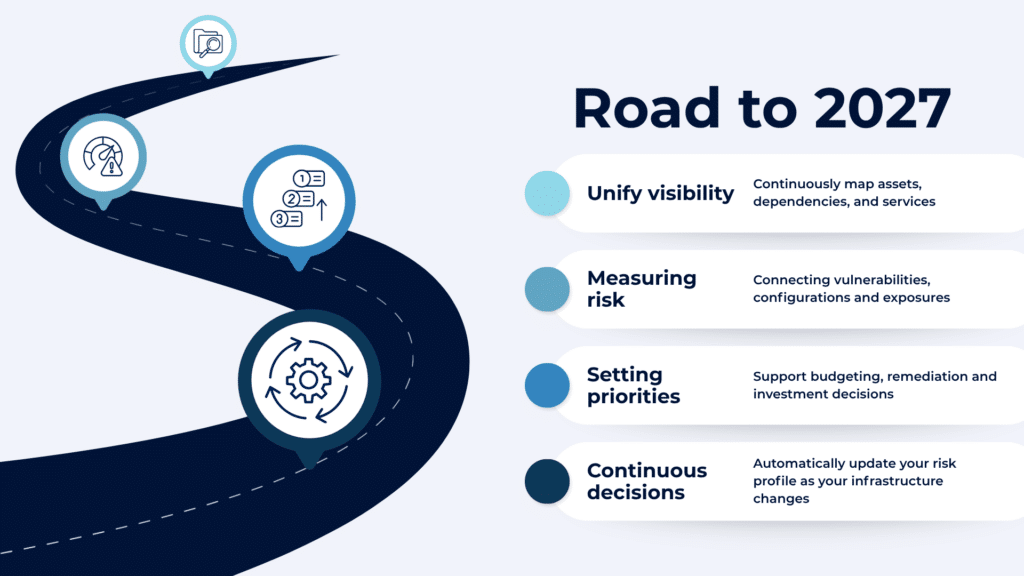
In 2027, the value of Cyber Risk Management platforms will increasingly depend on their ability to support information throughout the entire decision-making chain, transforming technical data—once contextualized through exposure and risk assessments—into actionable support for business decisions.
Information fragmentation is becoming the new limitation
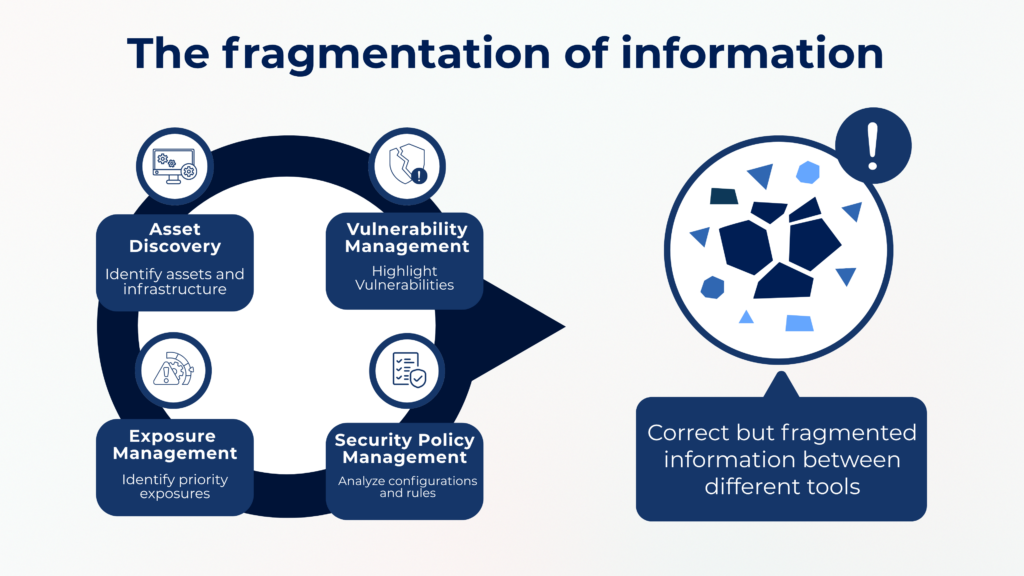
The adoption of specialized tools has improved visibility across many areas of cybersecurity, but it has also created an often underestimated side effect: fragmentation of the information landscape.
Each solution describes one part of the problem. An Asset Discovery system identifies what exists within the infrastructure, while a Vulnerability Management platform highlights its vulnerabilities. Security Policy Management tools focus on analyzing security configurations and rules, while Exposure Management platforms identify the exposures that deserve the greatest attention. Each of these sources of information is valid within its own context, but rarely provides enough insight, on its own, to support a decision.
Cyber risk emerges from the relationships connecting assets and services through the dependencies and configurations that link them to business processes. When this information remains distributed across different tools, correlation continues to depend on specialist interpretation and manual analysis.
A value chain for Cyber Risk Management
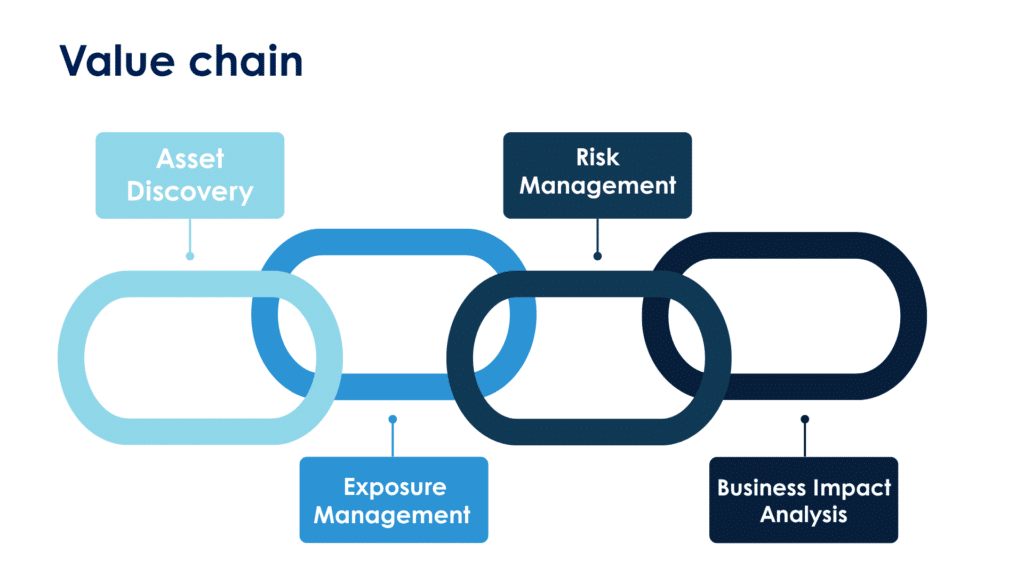
To address this complexity, it becomes useful to view Cyber Risk Management as a true value chain, in which each layer adds context and meaning to the one before it.
The first layer is represented by assets, meaning knowledge of the digital infrastructure. Understanding which systems make up the infrastructure, how they communicate with one another, and how they support business services is the foundation of any effective risk governance activity. On this foundation sits the exposure layer. Not all vulnerabilities represent the same level of risk: their relevance depends on asset reachability and network configurations, as well as on technological dependencies that may create potential attack propagation paths.
Exposure analysis becomes valuable when it is translated into risk. At this stage, technical information is interpreted in light of the probability of compromise and then translated into the operational consequences that may affect business services. The final layer concerns the business. A risk assessment becomes truly useful when it helps establish priorities for investment, providing substance to budget requests and ensuring that decisions remain aligned with the organization’s strategic objectives. This continuity represents a fundamental step toward a more mature governance model.
Read the article for the Value Chain of Cyber Risk
Value comes from connecting the different layers
For many years, the maturity of security platforms was assessed primarily on the basis of the features they offered or the amount of data they could collect. Today, that criterion is no longer sufficient. The value of a platform increasingly depends on its ability to maintain a continuous connection across all layers of the decision-making chain.
A vulnerability is more than a simple technical finding: it is an element capable of changing the risk profile of a specific business service. Likewise, a change in the infrastructure should automatically be reflected in risk assessments and, consequently, in decisions already made by management. The objective is to reduce the distance between technical evidence and strategic decision-making. Simply increasing the volume of available information is no longer enough.
From operational support to decision support
This evolution is also changing the role of Cyber Risk Management platforms. Traditionally, these platforms have been used to inventory assets and collect vulnerability information, supporting reporting activities and regulatory compliance. In the near future, they will be expected to perform a broader function: becoming true decision-support tools. This means providing a dynamic representation of risk, capable of evolving alongside the infrastructure and automatically correlating information from different domains, ultimately measuring how each change affects the organization’s overall risk profile.
In this scenario, risk becomes a parameter through which different alternatives can be evaluated, helping organizations determine both investment priorities and operational priorities.
Preparing for 2027
Organizations looking to strengthen their Cyber Risk Management model should assess individual technologies not only on the basis of the features they provide, but also on their ability to contribute to a continuous decision-making process.
Every new piece of data collected should be contextualized and correlated with the information already available, allowing it to become knowledge that can effectively support risk governance. Preparing for 2027 means building a model capable of carrying every piece of information across the entire Cyber Risk Management value chain: from technical data to exposure, from risk analysis to business decisions.
This continuity represents the next level of maturity in cyber governance: a model in which value comes from the ability to consistently and coherently transform information into decisions that strengthen the organization’s resilience and competitiveness.
A critical vulnerability on an endpoint and a board-level decision seem to belong to two different worlds, and yet the distance between them is what tests […]
In many organizations, application risk gets associated mainly with the most visible systems, the ones that support essential processes and therefore stay under the constant attention […]
When a risk analysis returns a reassuring rating across several areas of the perimeter, a company typically interprets the result as confirmation of its security posture. […]
Many security reports presented to the Board of Directors are still built around technical metrics that do not enable decision-makers to fully understand the organization’s real […]
Risk is not a Checklist. It’s a system of relationships. In cyber risk, a simplification continues to spread that, while convenient to adopt, struggles to hold […]
Artificial intelligence is rapidly entering business processes, influencing operational decisions, customer interactions, and business models. However, the discussion often tends to focus on technological aspects, while […]
The historical model: control, inventories, assessments For many years, Cyber Risk Management was interpreted as a simple control exercise, limited to specific and infrequent moments in […]
In recent years, Cyber Risk has been undergoing continuous transformation in terms of regulations, technologies, and methodological approaches. This transformation is often addressed by building increasingly […]
At the beginning of November, something happened that, until recently, seemed like a purely theoretical hypothesis. Anthropic released a report that made many industry professionals stop […]