The Cyber Risk Value Chain: from technical data to business impact
Cyber Security
A critical vulnerability on an endpoint and a board-level decision seem to belong to two different worlds, and yet the distance between them is what tests those who work in cyber risk every day. Between these two extremes lies a path made up of distinct steps, each of which transforms raw information into an element increasingly closer to the language of business.
Let us try to reconstruct this path as a value chain, starting from assets and arriving at economic impact, in order to understand where the solutions currently available on the market stand today and where ai.esra’s proposal is positioned instead.
A chain with four links
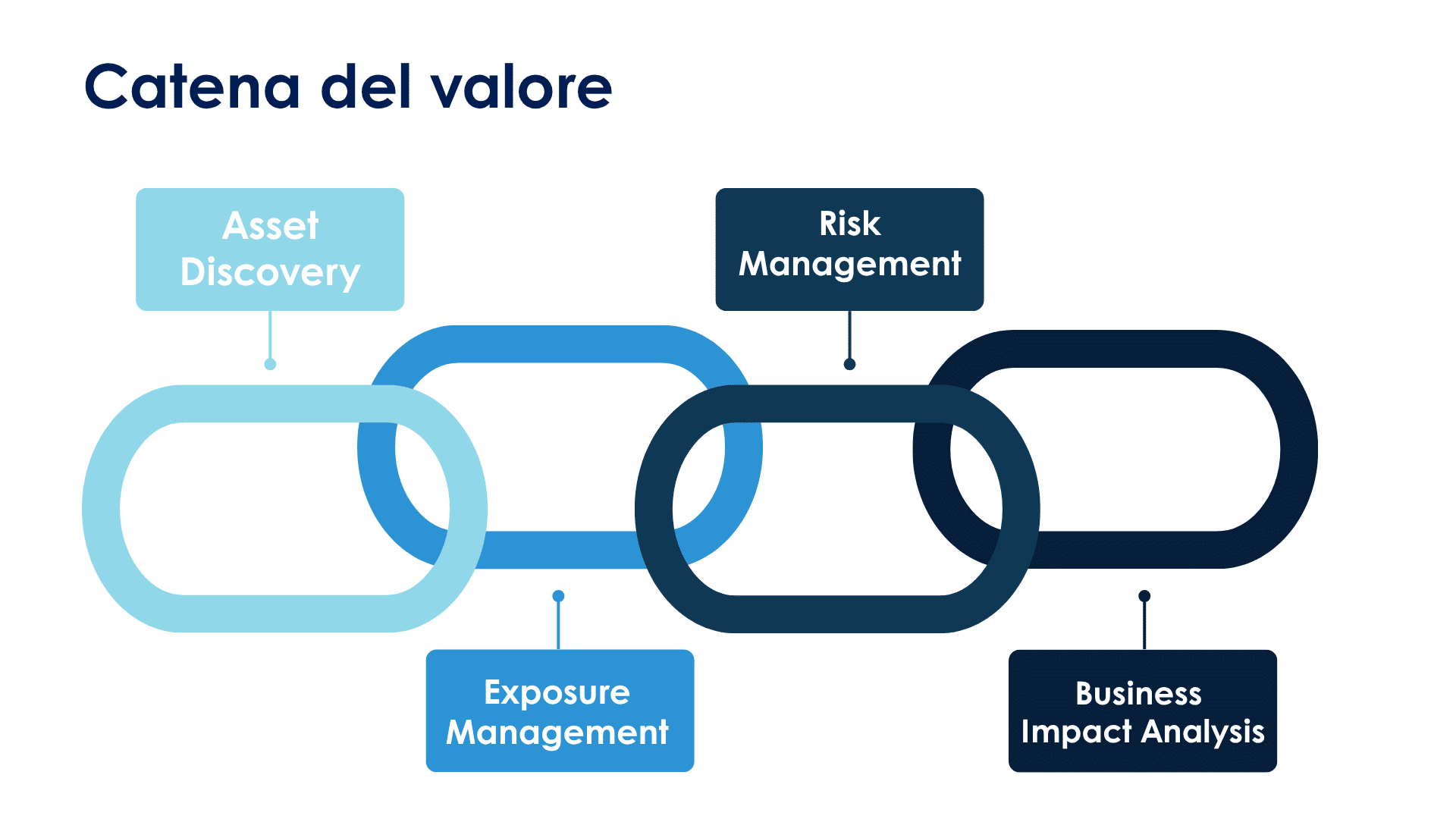
The Cyber Risk chain can be divided into four phases, connected to one another by a relationship of progressive dependency, since each level is built on the output produced by the previous one.
Without a complete and up-to-date asset inventory, any assessment risks resting on inconsistent foundations, since an uncatalogued infrastructure is, by definition, a blind spot. The output of this phase is therefore the mapping of the technological perimeter, including IT devices, cloud environments, and OT and IoT components, which in recent years have considerably expanded the surface to be monitored.
The second link includes Exposure Management, which works on the assets that have been identified in order to establish which of them are actually exposed to a concrete risk. Not all assets carry the same weight, just as not all vulnerabilities deserve the same urgency of intervention; for this reason, it is important to methodically transform a technical list into an operational order of priority. The expected output is a hierarchy of actions, built not on the number of vulnerabilities detected, but on their actual exploitability within the specific context.
With the third link, Risk Management, we enter into the substance of real risk, deriving from the actual exposure identified in the previous link, combining probability and impact into scenarios built on correlations and simulations. It is at this level that technical data begins to become the language of risk, since the question being answered is no longer which vulnerabilities exist, but rather which risk scenarios these vulnerabilities may generate if combined with one another or with other contextual factors.
In the fourth link, Business Impact Analysis, risk scenarios are translated into a language that the board can use to make strategic decisions. The questions guiding this phase concern the operational consequences in the event of exploited vulnerabilities, the most effective direction for investments, and the expected return from each control introduced. The output is decision-making support, designed for those within the company who must allocate budgets and define strategic priorities.
Why an overall view is needed
Each link in this chain focuses on a specific area and delivers a distinct benefit to the customer. Over the years, this organizational model has led to the emergence of product categories that focus on specific aspects of cyber risk, such as Asset Discovery, Vulnerability Prioritization, and Firewall Assurance.
However, in order to address organizations with increasingly complex structures, it is now becoming increasingly necessary to observe the four identified levels as a continuous flow rather than as separate compartments.
Information that originates as a simple technical attribute of an asset, if followed along the entire chain, can ultimately determine a strategic decision at board level, becoming enriched at every step with context and relevance. It is like a wave that passes through the entire chain, gathering increasingly meaningful information, until it transforms an infrastructural detail into an element aimed at decision-making processes.
A market that responds in fragments
If we look at the solutions currently available on the market, we notice that practically none of them covers the entire chain satisfactorily, because each vendor has specialized in one or two specific links of the value chain.
On the Asset Discovery front, solutions have emerged that are capable of building complete inventories and extending visibility to IoT and OT environments. However, their strength is exhausted when it comes to going beyond mapping, since their coverage drops significantly as soon as one wants to examine the vulnerabilities related to the identified assets, and even more so when one needs to analyze the risk of any exploited vulnerabilities.
On the Exposure Management front, instead, we find platforms that excel at technically prioritizing vulnerabilities through tools such as attack path analysis and exposure scoring. But here too, coverage remains strong within its own domain and progressively weakens as one moves toward Risk Management and Business Impact Analysis, which remain marginal territories for these vendors.
At the opposite end of the chain are applications that solidly cover both Risk Managementand Business Impact Analysis, offering scenario simulations and decision-making support for management. Their weakness, however, appears upstream, where Asset Discovery and Exposure Management capabilities remain limited, forcing these platforms to depend on data imported from other solutions in order to feed their models.
The result is a market in which, in order to cover the entire value chain, an organization is forced to adopt multiple solutions at the same time, integrating them with one another through work that is often manual and accepting that the most valuable part of the chain, the one that speaks the language of the board, is based on static estimates rather than on the live state of the infrastructure.
The vision of ai.esra
It is within this scenario that ai.esra’s proposal fits, built around an idea different from that of simply adding together tools specialized in each link: a Full Cognitive Risk Management platform in which, starting from the technical data related to asset mapping, it is possible to produce analytical data capable of suggesting to the board the strategic decisions to be taken for the business.
Instead of having data pass from one platform to another through exports and integrations, the digital twin maintains a constantly updated representation of the assets, their relationships, and the business context to which they belong, and on this representation the assessment of exposures, the simulation of risk, and the quantification of economic impact are carried out in sequence.
The ai.esra approach changes the very nature of the chain, which ceases to be a sequence of static reports produced by different tools and becomes a single model that can be queried in every direction and is capable of transforming technical data into strategic decisions for the business. A technical intervention, such as the remediation of a critical vulnerability on an OT asset, immediately translates into a calculable variation in exposure, associated risk, and the economic impact figure shown to the board, without anyone having to manually reload data or chase an integration between separate systems.
In the same way, when management wants to assess where to allocate a security budget, it can simulate the effect of an investment and observe its impact along the entire chain, down to the technical level of the individual assets involved, before spending even a single euro.
In many organizations, application risk gets associated mainly with the most visible systems, the ones that support essential processes and therefore stay under the constant attention […]
When a risk analysis returns a reassuring rating across several areas of the perimeter, a company typically interprets the result as confirmation of its security posture. […]
Many security reports presented to the Board of Directors are still built around technical metrics that do not enable decision-makers to fully understand the organization’s real […]
Risk is not a Checklist. It’s a system of relationships. In cyber risk, a simplification continues to spread that, while convenient to adopt, struggles to hold […]
Artificial intelligence is rapidly entering business processes, influencing operational decisions, customer interactions, and business models. However, the discussion often tends to focus on technological aspects, while […]
The historical model: control, inventories, assessments For many years, Cyber Risk Management was interpreted as a simple control exercise, limited to specific and infrequent moments in […]
In recent years, Cyber Risk has been undergoing continuous transformation in terms of regulations, technologies, and methodological approaches. This transformation is often addressed by building increasingly […]
At the beginning of November, something happened that, until recently, seemed like a purely theoretical hypothesis. Anthropic released a report that made many industry professionals stop […]